


If you’re running an online store, Klaviyo and Omnisend are almost certainly the two names on your shortlist. Both were built for eCommerce from day one, both integrate deeply with Shopify and WooCommerce, and both will tell you they’re the obvious choice.
I’ll disclose my position upfront: Omnisend is our #1 eCommerce pick in our annual email marketing software comparison, and has been a fixture in that list since 2017. So you can probably guess where this lands.
But Klaviyo is a genuinely good product — one of the first platforms to take eCommerce email seriously, now used by over 100,000 stores — and there are situations where I’d pick it over Omnisend without much hesitation. This comparison covers both sides.
A quick note on where the claims come from. As part of our annual email marketing research, we survey thousands of email software users and test the major platforms side by side — the observations below draw on that testing plus hands-on use across our own ventures. Where I quote a price, it’s what we verified at the time of writing; both companies adjust pricing often enough that you should check the calculators before committing.
The verdict, upfront
For most Shopify and WooCommerce stores, Omnisend is the better choice. At 10,000 contacts you’ll pay around $132/mo on Omnisend Standard versus $150+ on Klaviyo, and for that lower price you get more granular revenue attribution, plus email, SMS, and web push as native steps in a single workflow. Klaviyo doesn’t do web push at all.
Klaviyo’s counterpunch is analytics depth. Its predictive forecasting and peer benchmarks are the best I’ve seen in this category, its templates are beautifully designed, and it has more agency and ecosystem mindshare than any other eCommerce ESP. For a large store with a dedicated email team — particularly on Shopify Plus — that depth can justify the premium.
The thing that tips this comparison further in Omnisend’s favour is switching cost. Omnisend’s team will migrate you off Klaviyo for free on any paid plan — lists, automations, templates, deliverability setup, the lot. More on that below.
Klaviyo vs Omnisend at a glance
| Round | Winner | Why |
|---|---|---|
| Pricing | Omnisend | ~$132/mo vs $150+ at 10K contacts; gap widens at scale |
| Automation & omnichannel | Omnisend | Email + SMS + push in one workflow; Klaviyo lacks web push and split-testing paths |
| Revenue attribution | Omnisend | More granular — down to the A/B variant that drove each sale |
| Shopify/WooCommerce integration | Draw | Omnisend for most stores; Klaviyo edges it on Shopify Plus |
| Segmentation | Klaviyo (narrowly) | Marginal edge for very large stores with complex data |
| SMS | Omnisend | Pro plan bundles SMS credits equal to your plan cost |
| Reporting | Klaviyo | Predictive forecasts and peer benchmarks Omnisend can’t match |
| Support | Omnisend | 24/7 live chat, ~4 minute average response |
Round 1: Pricing
This is the round most stores actually decide on, so let’s start here.
At 10,000 contacts, Omnisend Standard costs around $132/mo. Klaviyo at the same list size is $150+, and in our Shopify email marketing comparison the gap held at every list size we checked — Klaviyo costs more than Omnisend at almost any number of contacts, and at the 100K tier the difference stops being pocket change.
Entry pricing is closer. Omnisend Standard starts at $16/mo for 500 contacts; Klaviyo starts at $20/mo. Both offer free plans covering 250 contacts and 500 emails a month — near-identical on email, though Klaviyo’s includes 150 SMS to Omnisend’s 60, while Omnisend’s includes 500 web push notifications, a channel Klaviyo doesn’t have.
Two caveats keep this honest. Omnisend’s free plan is best treated as an extended demo — 250 contacts won’t run a real store, so budget for Standard from day one. And Standard caps email sends at 12x your contact list per month, which is fine for most stores but a ceiling if you’re sending daily promotions.
Neither caveat changes the outcome. Same list, comparable features, smaller invoice.
Winner: Omnisend.
Round 2: Automation and omnichannel
Omnisend’s automation builder is the reason the company is called Omnisend. Email, SMS, and web push are native steps in a single visual workflow — send an email, wait 24 hours, fire an SMS if it went unopened, all without stitching tools together. In our testing, that fallback logic is built in rather than bolted on, and it’s noticeably less buggy than the integrations you’d assemble to replicate it elsewhere.
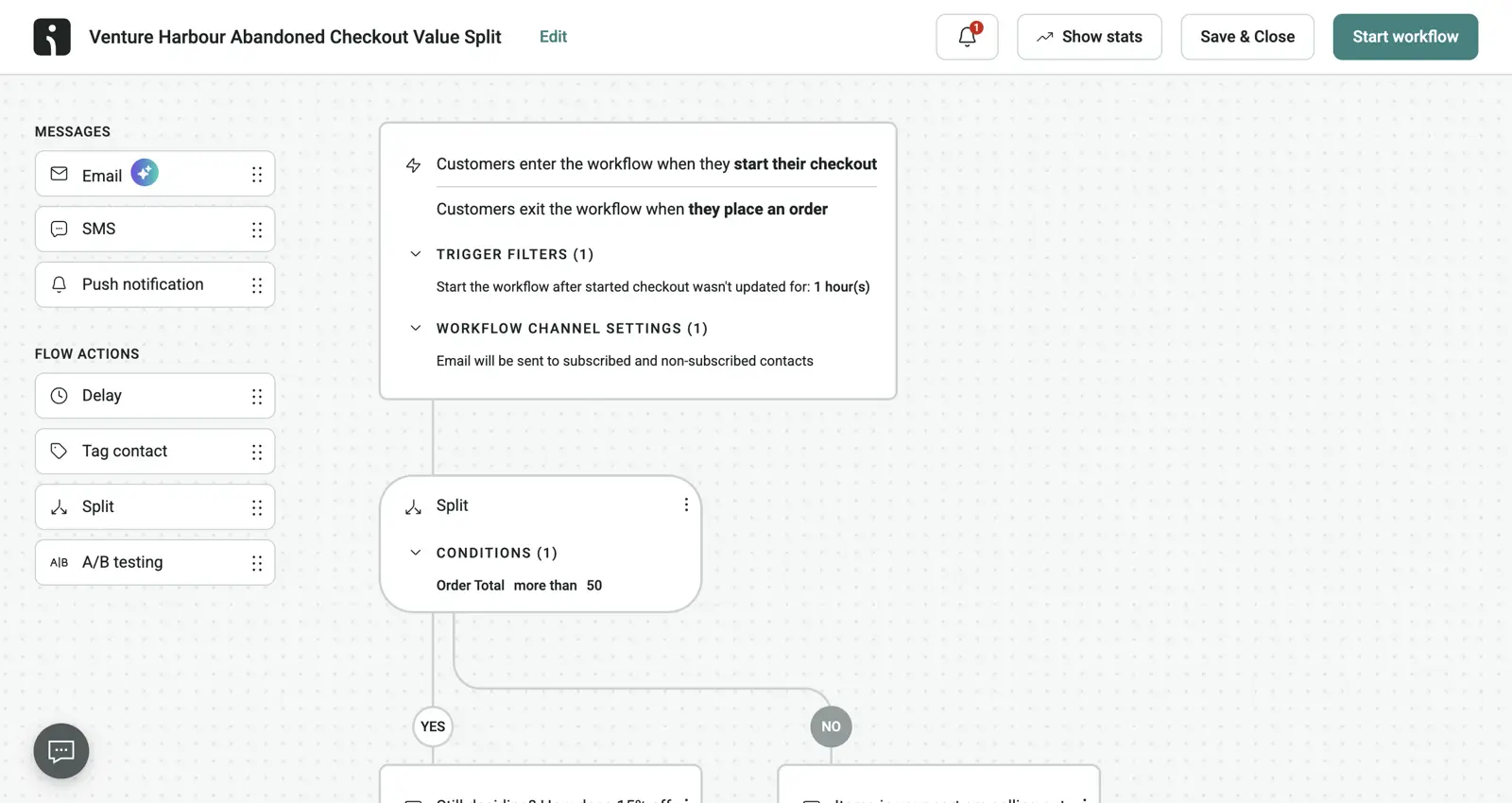
You can also A/B test entire workflow paths — does adding an SMS step to abandoned cart recover more revenue than email alone? — and see the answer in revenue, not opens. Few automation tools let you do this at all, and it’s the closest thing I’ve found to a set-and-forget optimisation loop in an ESP.
The pre-built flows deserve a mention too. Welcome series, abandoned cart, browse abandonment, post-purchase, win-back — all wired up to your store data the moment you connect, so switching them on is a matter of reviewing the copy and adjusting the timing.
Klaviyo’s flow builder is easy to use and covers the automations an eCommerce store actually needs — welcome, abandoned cart, post-purchase, win-back. No complaints on the basics.
But there are two notable omissions. Klaviyo doesn’t support split-testing paths within its automation flows, and its pre-built automation templates are on the simplistic side. Add the missing web push channel and the omnichannel picture is clearly less complete.
Winner: Omnisend.
Round 3: Revenue attribution and reporting
This round splits in two, and each platform takes half.
Attribution first. Omnisend traces every dollar of revenue back to the exact email, SMS, automation step, and A/B variant that drove it — based on actual order data from your store, not UTM guesswork. It’s the single feature I rely on most in the platform, and it’s more granular than what Klaviyo offers. I’ve covered it in detail in our full Omnisend review.
Klaviyo’s attribution is strong too, to be fair. The gap is in granularity, not capability.
Reporting is where Klaviyo pulls ahead. Its predictive analytics forecast your future revenue and model when a customer is likely to buy again, and its benchmarks compare your performance against similar eCommerce businesses — a tangible target for everything from open rates to revenue per recipient. It’s one of my favourite features in Klaviyo, and Omnisend has no real answer to it.
Klaviyo’s custom reporting is also more flexible at the enterprise tier. Omnisend’s dashboards are clean and cover the essentials, but power users bump into their edges.
Winner: Omnisend on attribution, Klaviyo on reporting depth. If forced to pick one, I’d take attribution — it answers the question that actually pays the bills.
Round 4: Shopify and WooCommerce integration
Both platforms integrate natively and deeply with Shopify and WooCommerce, so this round is closer than the marketing on either side suggests.
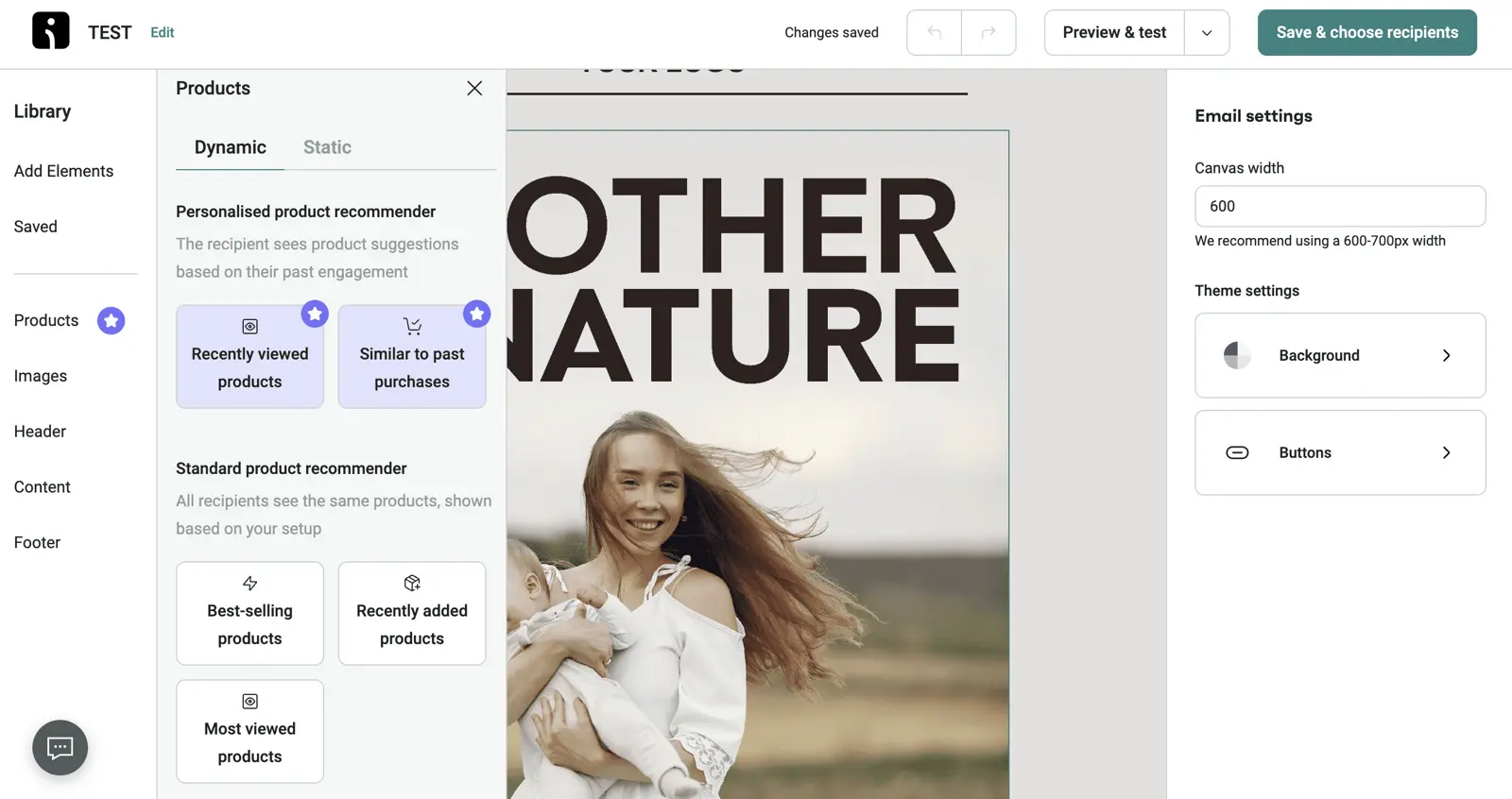
Omnisend’s setup is the standout. Connect your store and it pulls in your product inventory, store styling, customer list, and order history automatically — most stores are sending their first campaign within 15-20 minutes of signup. Its Shopify app holds a 4.8-star rating with 5,000+ five-star reviews, the product picker pulls live from your catalogue, and abandoned cart triggers fire reliably.
Klaviyo matches the fundamentals and edges ahead in one place: Shopify Plus. Its deeper Shopify Plus integrations are the main reason large stores still default to it, and if you’re at that scale, that’s a fair reason.
One gripe on the Omnisend side to balance things: its email templates are visually underwhelming compared to Klaviyo’s, which are some of the best-designed we’ve seen. If you have no in-house design support, Klaviyo’s templates alone could save you a designer’s invoice.
Winner: draw. Omnisend for most stores, Klaviyo for Shopify Plus.
Round 5: Segmentation
Omnisend excels at purchase-based segmentation — total spend, average order value, last purchase date, lifecycle stage — and its natural-language segment builder lets you describe an audience in plain English (“lapsed buyers who spent over $200 last year”) and have the segment built for you. For the segments an eCommerce store actually sends to, it covers the ground comfortably.
It’s weaker on behavioural signals beyond transactions, though, and that’s where Klaviyo earns this round. For very large stores with complex data models — the 50K+ contact range — Klaviyo’s segmentation depth has a marginal edge, and its predictive properties (expected next order date, predicted lifetime value) feed directly into it.
Marginal is the operative word. Most stores will never touch the difference.
Winner: Klaviyo, narrowly — and only at the top end.
Round 6: SMS
Both platforms treat SMS as a first-class channel rather than an afterthought, which already puts them ahead of most of the category.
The pricing structures differ meaningfully. Omnisend’s Pro plan bundles free SMS credits equal to your monthly plan cost — $59 of SMS on the $59/mo plan — whereas SMS on Klaviyo sits on top of your already-higher email bill. On the free tiers the positions reverse: Klaviyo gives you 150 SMS a month to Omnisend’s 60.
Omnisend’s SMS also lives inside the same workflows as email and push, which is where the channel does its best work — SMS follow-ups on unopened abandoned cart emails, that sort of thing. One thing to watch on Omnisend: SMS credit costs vary by destination country, which makes international SMS budgets harder to forecast.
Winner: Omnisend, on the strength of the Pro plan bundling.
Round 7: Support
Short round. Omnisend runs 24/7 live chat and email support with an average response time of around 4 minutes — the fastest we’ve seen in this category by some margin. The answers come from people who clearly understand how stores work, not from a script.
Klaviyo’s ecosystem partly compensates here: more agencies and freelancers know Klaviyo than any other eCommerce ESP, so hiring outside help is easier. If your support model is “retain an agency”, that mindshare has real value.
For direct support from the platform itself, though, it’s not close.
Winner: Omnisend.
Switching from Klaviyo: the free migration
Here’s the part that changes the maths for anyone already on Klaviyo.
The honest reason most stores stay on an ESP they’ve half-outgrown isn’t the product — it’s the migration. Rebuilding automations, recreating templates, re-warming deliverability… it’s the kind of project that sits on a roadmap for two years before anyone bites the bullet. I’ve watched it happen across our own ventures.
Omnisend has removed that barrier almost entirely. There’s a self-serve migration tool that automatically syncs your contacts, properties, tags, segments, and engagement stats from Klaviyo (or any other ESP). And on any paid plan, Omnisend’s team will handle the migration for you at no extra cost — list imports, automation rebuilds, template recreation, and deliverability setup, all done by their people rather than yours.
In Omnisend’s own words: “We’ll pack, carry, set up, and switch on the lights — you just walk in and start selling.”
Klaviyo offers no equivalent. So the switching decision stops being “is Omnisend better enough to justify a two-week migration sprint?” and becomes “is Omnisend better for my store?” — a much easier question. For most stores under the enterprise tier, the answer is yes, and the annual saving at 10K contacts is a couple of hundred dollars before you count the bundled SMS.
The one cost that remains is the soft kind: your team knows Klaviyo, and there’s a learning curve on any new platform. Omnisend’s is shallow — but it isn’t zero.
If you do make the move, keep your Klaviyo account read-only for a month or so. Historic campaign data is the thing people realise they need three weeks after they’ve cancelled.
Where Klaviyo is still the right call
I want to be fair here, because “Omnisend wins” isn’t the whole story.
I’d pick Klaviyo if you’re a large eCommerce business with a team dedicated to email and SMS. Its predictive insights — revenue forecasts, peer benchmarks, expected purchase dates — are genuinely useful at that scale, and nothing in Omnisend matches them. The deeper Shopify Plus integrations matter at the enterprise end too.
I’d also lean Klaviyo if design resource is your bottleneck. Its campaign builder is smoother than Omnisend’s and its templates are a class above — enough that a small team without a designer can ship professional campaigns on templates alone.
And if you’re heavily agency-dependent, Klaviyo’s mindshare means more people who can run your account. That’s not a product feature, but it’s a real operational advantage.
What I wouldn’t do is pay Klaviyo’s premium for a standard Shopify or WooCommerce store doing standard eCommerce email. At that point you’re funding predictive analytics you’ll glance at twice a year.
Final verdict
For most eCommerce stores, Omnisend is the better platform and the better deal: around $132/mo versus $150+ at 10K contacts, more granular revenue attribution, native email + SMS + push workflows, faster support, and a free done-for-you migration that makes switching from Klaviyo close to painless.
Klaviyo remains the right call for large stores with dedicated email teams, Shopify Plus operations, and anyone who’ll genuinely use its predictive analytics and best-in-class templates.
If you’re weighing up the wider field beyond these two, our eCommerce email marketing comparison covers the alternatives. Otherwise, Omnisend’s free plan covers 250 contacts with the full feature set — enough to kick the tyres properly before you commit to moving anything.