


As part of our annual research, we survey thousands of email software users and test the major platforms side by side. Klaviyo was one of the first platforms to take eCommerce email seriously.
But there are reasons people go looking for the exit. The price climbs faster than most stores’ revenue does, there’s no web push channel, you can’t split-test paths inside its automations, and the pre-built flows are on the simplistic side.
My position upfront: Omnisend has been our #1 eCommerce pick in our annual email marketing comparison since 2017, and I published a full Klaviyo vs Omnisend head-to-head. ActiveCampaign is also a paid Test Lab partner.
Prices reflect our published comparisons at the time of writing. Both Klaviyo and its rivals adjust pricing often enough that you should check the calculators before committing.
The short answer
For most Shopify and WooCommerce stores, Omnisend is the alternative I’d move to. At 10,000 contacts, it costs around $132/mo versus Klaviyo’s $150+, with email, SMS and web push in one workflow. Its templates and predictive reporting are weaker than Klaviyo’s.
If budget is the whole story, Brevo prices by email volume rather than contacts, which makes a big list on a light sending schedule almost embarrassingly cheap. And if your business is only half eCommerce, ActiveCampaign has the deepest automation builder I’ve used in 14 years of testing. Its AI can help critique sequences, though the output still needs checking.
Drip, Mailchimp and Shopify Email suit smaller stores with simpler sending needs.
Klaviyo alternatives compared
| Tool | Best for | From | At 10K contacts | Free plan |
|---|---|---|---|---|
| Klaviyo (for reference) | Enterprise eCommerce | $20/mo | $150+ | 250 contacts, 500 emails, 150 SMS |
| Omnisend | Most Shopify/WooCommerce stores | $16/mo | ~$132/mo | 250 contacts, 500 emails, 60 SMS |
| ActiveCampaign | AI-assisted lifecycle automation | $15/mo (annual) | $149/mo (Starter) | 14-day trial |
| Brevo | Budget email + SMS | $0 | ~$35/mo* | 300 emails/day, unlimited contacts |
| Drip | Small stores wanting simplicity | $39/mo | $154/mo | 14-day trial |
| Mailchimp | Cheap basics | $13/mo | ~$110/mo | 500 contacts |
| Shopify Email | Brand-new Shopify stores | Free | Free (10,000 sends/mo) | Yes |
*Brevo prices by email volume, not contacts; the 10K figure assumes roughly four emails per contact per month.
Omnisend
Test Lab Partner (Paid)Omnisend is a member of our Test Lab Programme, which means we receive a fee to conduct hands-on testing of their platform. Learn more about our Test Lab Programme →Omnisend was built for eCommerce from day one, and the setup reflects that. Connect Shopify or WooCommerce and it pulls in your product inventory, store styling, customer list, and order history automatically; most stores send their first campaign within 15-20 minutes of signup. Its Shopify app holds a 4.8-star rating with 5,000+ five-star reviews.
The pricing case against Klaviyo is straightforward. Omnisend Standard starts at $16/mo for 500 contacts against Klaviyo’s $20/mo, and at 10,000 contacts you’ll pay around $132/mo versus $150+. In our Shopify email comparison the gap held at every list size we checked.
Then there’s the feature Klaviyo simply doesn’t have: web push. Omnisend treats email, SMS, and push as native steps in one visual workflow. You can send an email, wait 24 hours and fire an SMS if it went unopened, and you can A/B test entire workflow paths with results measured in revenue, not opens. Klaviyo supports neither the push channel nor the path-testing.
Revenue attribution is the feature I rely on most. Every dollar is traced back to the exact campaign, automation step, and A/B variant that drove it, based on actual order data rather than UTM guesswork; more granular than Klaviyo’s, which is itself strong. I’ve covered it properly in our full Omnisend review.
Omnisend’s email templates are visually underwhelming next to Klaviyo’s, which are some of the best-designed we’ve seen. The Standard plan caps sends at 12x your contact list per month; fine for most stores, a ceiling if you send daily. And its reporting has no answer to Klaviyo’s predictive forecasts and peer benchmarks.
If you’re not running an online store at all, skip it entirely. The whole product assumes you’re selling things.
Choose Omnisend if: you’re a standard Shopify or WooCommerce store and the Klaviyo bill has started to sting.
ActiveCampaign
Test Lab Partner (Paid)ActiveCampaign is a member of our Test Lab Programme, which means we receive a fee to conduct hands-on testing of their platform. Learn more about our Test Lab Programme →I’ve used ActiveCampaign since 2012 across eight portfolio companies, sending over 124,000 emails. If your business combines a store with services, courses or B2B sales, its automation builder is the one I’d try first. Its CRM and reporting are still average, and reaching a human in support can be frustrating.
Active Intelligence gives it one of the best AI offerings among the email marketing tools I’ve tested, particularly for segmentation and improving existing sequences. In our ActiveCampaign review, it created a segment from a plain-English request and spotted an unfinished A/B test, high unsubscribes and a missing preheader in an onboarding sequence.
The email-building test was less tidy: it ignored my request for one image and a single-column layout. I’d use it to draft and critique campaigns, with someone checking the output before anything goes live.
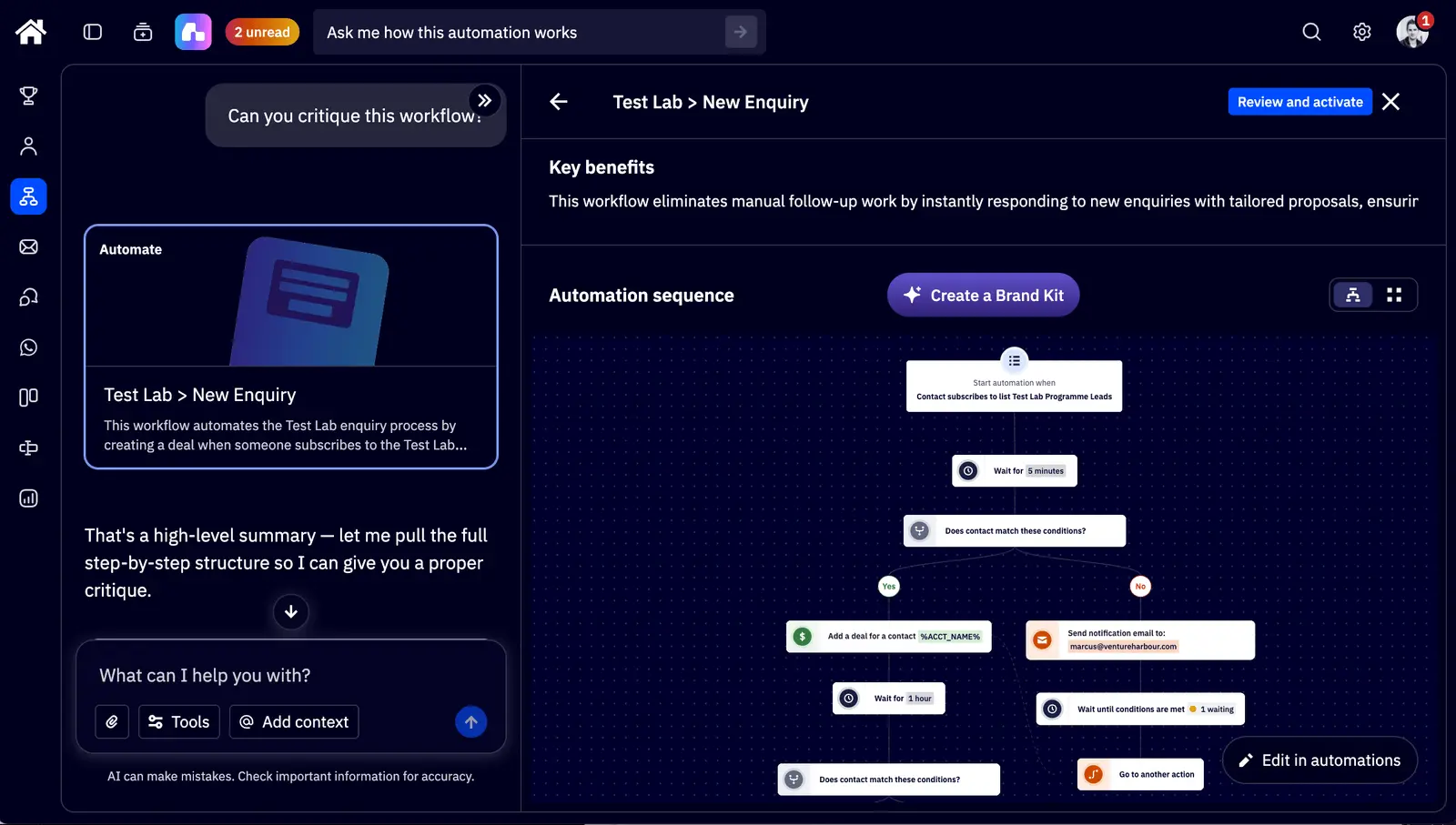
When I asked it to implement improvements, it added goal exits, a day-seven re-engagement branch and a 48-hour resend to non-openers. It struggled with the A/B testing task in that test, rebuilding an email instead of changing a single element. I’d still check every variant myself.
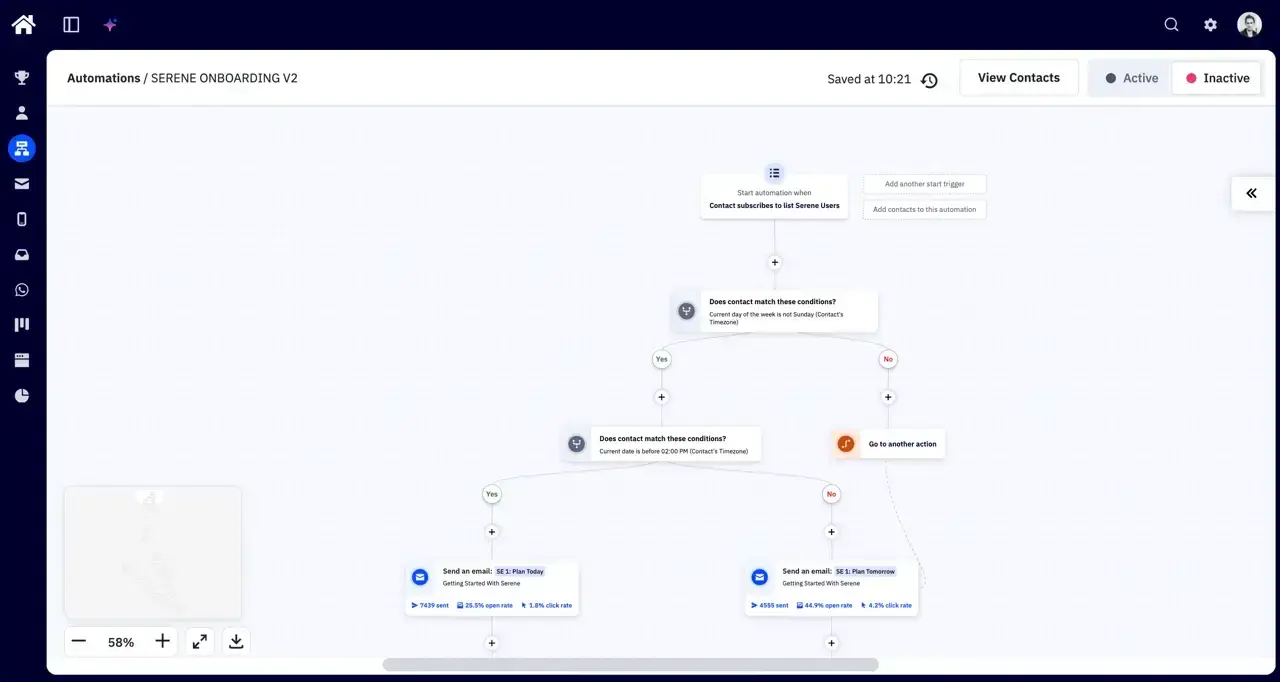
The underlying automation builder handles conditional branches and split tests across whole paths. Our Serene onboarding flow uses the contact’s local day and time to choose which welcome email they receive (a useful distinction for a daily planning app).
That depth is harder to justify if you only need a newsletter and an abandoned-cart reminder. You’ll spend time configuring options a simpler store may never use.
Starter begins at $15/mo for 1,000 contacts on annual billing, but I’d budget for Plus or Pro if automation and AI are your reasons for switching. Check the plan comparison against the features you need; the entry price leaves out much of what I’d choose it for.
New accounts created on or after 3 November 2025 are billed for unsubscribed and bounced contacts too. Clean your list before importing it, and factor in AI activity limits alongside the subscription cost. There is a 14-day trial, but no permanent free plan.
The video shows the tests behind our review, including where Active Intelligence needed more work.
Choose ActiveCampaign if: you need automation beyond store transactions and want AI help building segments or improving sequences. For a straightforward shop, Omnisend is easier to justify on cost.
Brevo
Brevo (formerly Sendinblue) does one thing structurally differently: it prices by email volume rather than contacts. Unlimited contacts on every plan, including the free one; you pay only for what you send. The free plan allows 300 emails a day, and the Starter plan covers 20,000 emails for $25/mo.
For the right sending pattern that’s a rounding error next to Klaviyo. A large list on a monthly newsletter costs almost nothing; the same list on Klaviyo prices by headcount whether you email them or not.
I’ve used Brevo since 2016 and sent 640,199 emails through it across our ventures without much drama. It bundles SMS, WhatsApp and transactional email, useful if your store sends order confirmations and password resets from the same account.
SMS credits cost extra, unlike Omnisend’s Pro plan, which includes SMS credits equal to your monthly plan cost. The automation has a low ceiling: no split-testing paths, no predictive sending, and nothing close to Omnisend’s eCommerce depth; no product picker pulling from your catalogue, no revenue attribution of the same grade. And we’ve seen recurring complaints about accounts being throttled when send volume spikes.
Choose Brevo if: the invoice is the deciding factor, your sending is moderate, and you can live with simpler automation.
Drip
Drip pivoted to eCommerce after its Leadpages acquisition, and it wears the change a bit loosely; it often feels like a generic email tool with eCommerce sprinkled on top. But it’s refreshingly quick to get running, the templates are well-designed, and the single-plan pricing is easy to reason about: $39/mo for up to 2,500 contacts, unlimited emails, every feature included.
The ceiling arrives fast. There are only nine pre-built automation templates for Shopify users (and calling some of them templates is generous), the workflow builder has no drag-and-drop, and the action list is short. At 10,000 contacts it’s $154/mo; more than Omnisend for a fraction of the automation.
The redeeming quality of that simplicity: if you outgrow Drip, you’ll do it before you’ve built anything painful to migrate.
Choose Drip if: you’re a small store with basic needs and you value getting set up in an afternoon over long-term headroom.
Mailchimp
Mailchimp is cruising on its reputation. It’s the name every store owner knows, it starts at $13/mo with a free plan for 500 contacts, and at 10,000 contacts it runs around $110/mo; cheaper than Klaviyo and Omnisend both.
But you feel where the money went. There’s no native SMS (it’s an add-on), no web push, the automation is limited, and revenue attribution is basic where Omnisend’s is the best in the category. Our migration data shows a consistent pattern: users leaving Mailchimp, almost nobody moving to it.
Switching from Klaviyo to Mailchimp would be trading analytics depth for a slightly smaller invoice. I’d choose Omnisend if automation is central to the store, though its templates are weaker than Klaviyo’s.
Choose Mailchimp if: you send basic campaigns, automation barely features in your plans, and the brand familiarity is worth something to you.
Shopify Email
If you’re a brand-new Shopify store still building your first list, the maths changes: you may not need a Klaviyo alternative so much as a free placeholder. Shopify Email is that. It’s free for up to 10,000 sends per month, needs no integration work, and sales are attributed to the right emails automatically; it does feel like magic having that work with zero setup.
You’re limited to six automation templates, with no A/B testing, mediocre template designs and an editor that sometimes needs a page refresh. I’d use it while building the store’s first list.
Choose Shopify Email if: you’re pre-revenue or close to it. Graduate to Omnisend’s free plan the moment you want automation that does more than the basics; our eCommerce email comparison covers that jump in detail.
Switching off Klaviyo: the free migration
Rebuilding a working setup can keep stores on a platform they’ve half-outgrown. Rebuilding automations, recreating templates, re-warming deliverability… it’s the project that sits on the roadmap for two years while the invoices keep arriving. I’ve watched it happen across our own ventures.
Omnisend offers help with that work. There’s a self-serve migration tool that automatically syncs your contacts, properties, tags, segments, and engagement data from Klaviyo (or any other ESP). And on any paid plan, Omnisend’s team will handle the entire migration for you at no extra cost; list imports, automation rebuilds, template recreation, and deliverability setup, all done by their people rather than yours.
ActiveCampaign also offers free migration help for qualifying plans, including contacts, templates and automations, as covered in our review. Confirm what each team will rebuild before choosing; complex workflows still need checking on the new platform.
One practical tip if you do move: keep your Klaviyo account read-only for a month afterwards. Historic campaign data is the thing people realise they need three weeks after cancelling.
When Klaviyo is still the right call
I’d keep Klaviyo if you’re a large eCommerce business with a team dedicated to email and SMS, particularly on Shopify Plus. Its predictive analytics, including revenue forecasts, expected purchase dates and peer benchmarks, are the best I’ve seen in this category, and nothing on this list fully replicates them. Its deeper Shopify Plus integrations matter at that scale too.
I’d also stay if design resource is your bottleneck. Klaviyo’s templates are a class above every alternative here; enough that a small team without a designer can ship professional campaigns on templates alone. Omnisend’s templates, by contrast, are its weakest area.
And there’s the ecosystem. More agencies and freelancers know Klaviyo than any other eCommerce ESP, so if your operating model is “retain an agency”, that mindshare has real operational value.
What I wouldn’t do is pay the premium as a standard store doing standard eCommerce email. At that point you’re funding forecasting features you’ll glance at twice a year.
Final verdict
For most Shopify or WooCommerce stores, I’d choose Omnisend for its pricing, revenue attribution and combined email, SMS and push workflows. Its templates and predictive reporting are weaker than Klaviyo’s. Our Klaviyo vs Omnisend comparison covers those differences.
Brevo is the pick when budget rules everything, ActiveCampaign when your automation needs run past pure eCommerce, and the rest serve narrower corners of the market.
Omnisend’s free plan covers 250 contacts with the full feature set; enough to kick the tyres properly before you move anything that matters.