

I tested ActiveCampaign and Mailchimp across the same eight tests to see which is the better platform for different use cases. For context, we’ve used both across our portfolio over the last 14 years, and we earn a commission when you sign up through the links on this page.
ActiveCampaign in particular has been used to send over 124,000 emails across eight of our portfolio companies.
Mailchimp surprised me in the latest test. Its email builder was the easiest I’ve used across dozens of tools we’ve tested, and has come a long way since I first used it over a decade ago. In the video you can also see some of Mailchimp’s newer AI features, which I’ve elaborated on in round six.
The scorecard
| Round | Winner | The gist |
|---|---|---|
| Pricing | Mailchimp | Lower entry price, plus a free plan |
| Automation | ActiveCampaign | Deeper journeys, richer triggers and automation split testing |
| Email builder | Mailchimp | The fastest editor in my latest tests |
| Deliverability | Draw | Both tested well, with stronger long-term data from our ActiveCampaign accounts |
| CRM | ActiveCampaign | Useful for automation, although limited as a sales CRM |
| AI features | ActiveCampaign | Better for segmentation and journey critique |
| Support | Mailchimp | Stronger result in the latest hands-on test |
Three rounds to Mailchimp, three to ActiveCampaign and one draw. The round count matters less than the use case: Mailchimp is easier for basic email, while ActiveCampaign is stronger for businesses where automations, segments and follow-up timing affect revenue.
Round 1: Pricing
Mailchimp has four marketing plans: Free, Essentials, Standard and Premium. The free plan covers 250 contacts and 500 monthly sends, Essentials starts at $13/month for up to 500 contacts, Standard starts at $20/month and Premium starts at $350/month.
ActiveCampaign has no free plan, only a 14-day trial. Starter begins at $15/month for 1,000 contacts on annual billing.
I would usually budget for Plus from $49/month because that is where the stronger automation and CRM-related features start to make sense.
At 10,000 contacts, the Mailchimp review has Standard at roughly $110/month. ActiveCampaign is $149/month on Starter or $189/month on Plus at the same list size.
That gives Mailchimp the price round. The downside is that its free plan is small, and billing can still become annoying because archived, subscribed and unsubscribed contact rules need watching as your list ages.
ActiveCampaign has its own caveat. Accounts created on or after 3 November 2025 are billed for all contacts, including unsubscribed, bounced and unconfirmed contacts, so clean your list before importing it.
Round 2: Automation
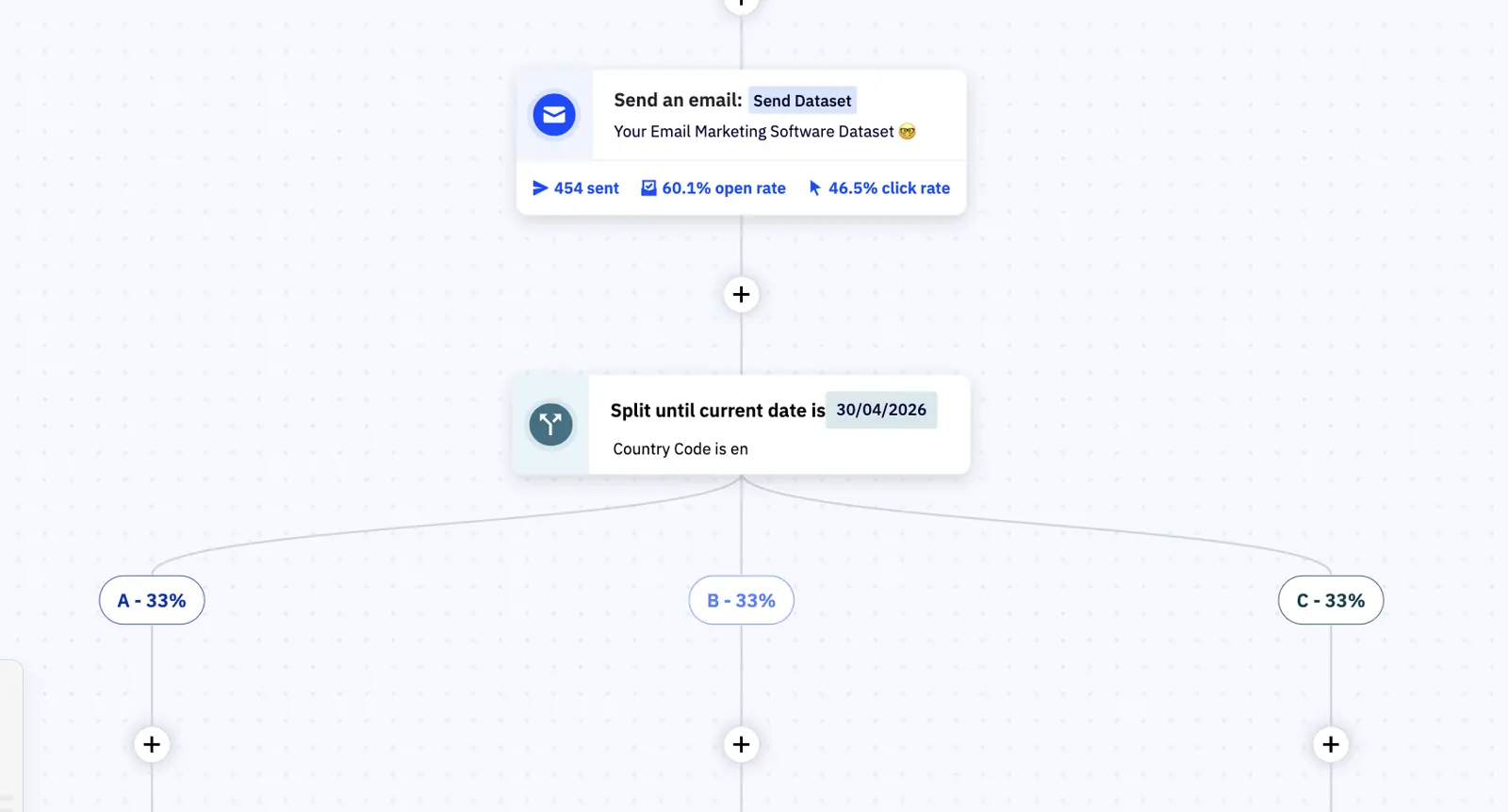
ActiveCampaign’s automation builder is the main reason I keep coming back to it. You get 135+ triggers, 950+ automation recipes, if/else logic, goals, webhooks, CRM actions and split testing for whole automation paths.
We have tested questions like whether 10 emails over a week beat five emails over a month, then left the winning path to keep improving the sequence.
Mailchimp’s automation builder was better than the old version I had in my head. In the September 2026 test, I built a three-email welcome sequence, added a one-day delay, created a split path and checked behavioural conditions without opening help docs.
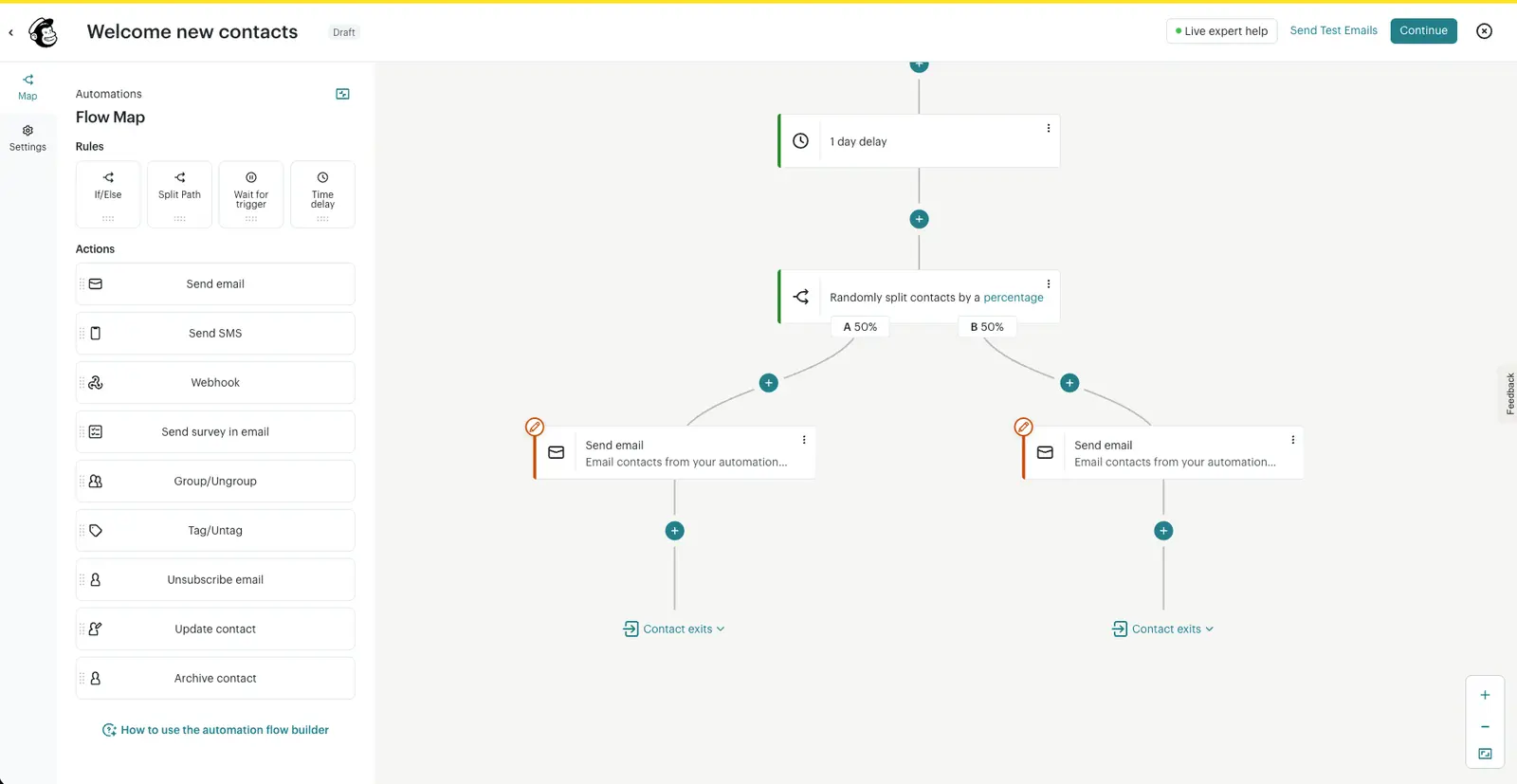
That is enough for welcome sequences, simple nurture, basic customer follow-up and early eCommerce email. The limitation appears when you want AI to critique a flow, add branches for you or trigger first-party actions in tools like Shopify or Google Sheets from inside the journey.
Choose ActiveCampaign if automation is the reason you are buying the tool. Choose Mailchimp if you mostly need the basics to be calm and obvious.
Round 3: Email builder
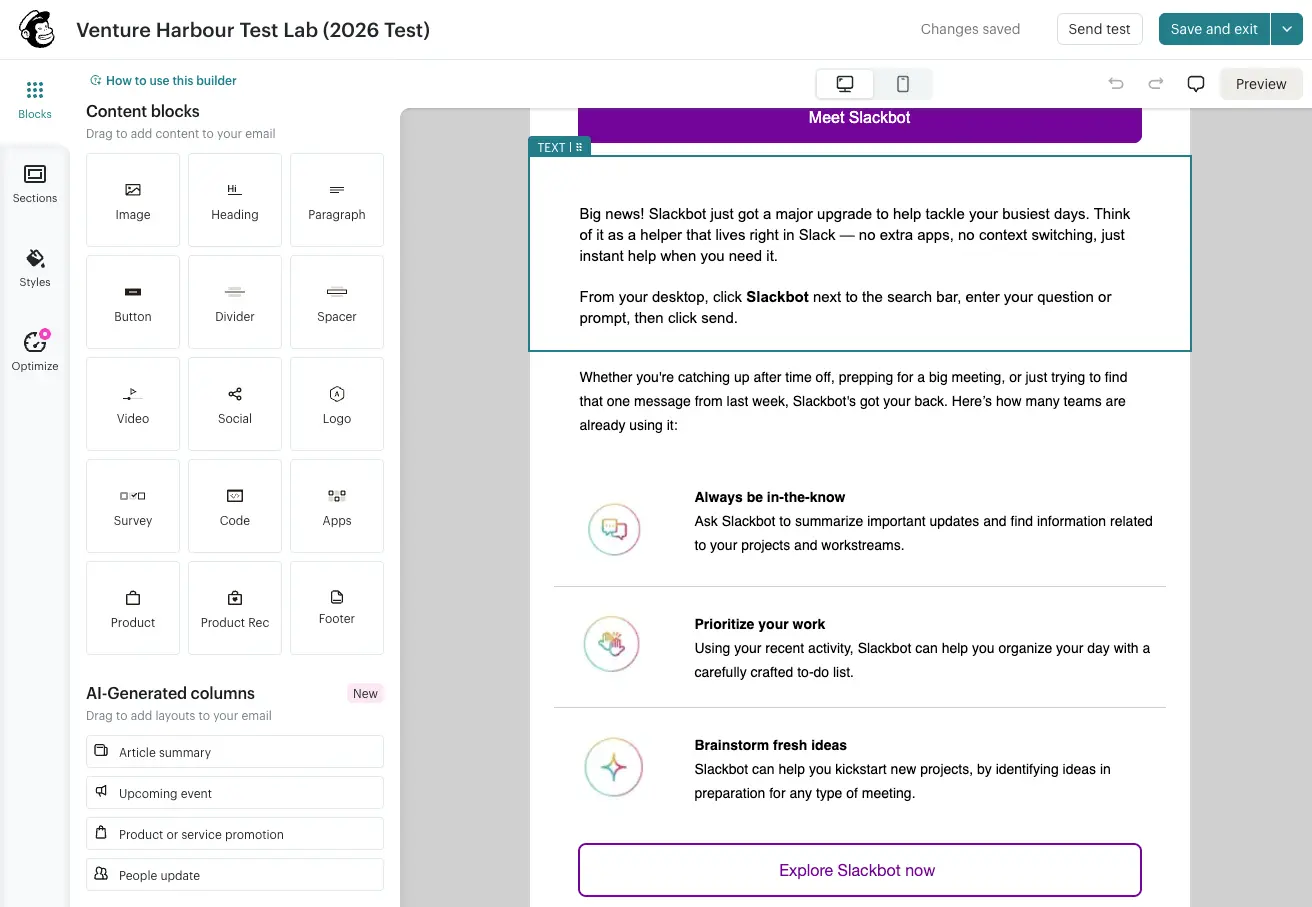
Mailchimp’s email builder is the strongest reason to choose it. I rebuilt a designed email campaign in eight minutes, which was faster than I managed in HubSpot, ActiveCampaign, Omnisend or Constant Contact.
The small touches help. Image sources, block controls and layout settings sit where I expected them, so I spent less time hunting around the interface.
ActiveCampaign’s builder is still good. It is drag-and-drop, auto-saving, has 250+ templates on the current pricing page, and can add countdown timers, videos, eCommerce product blocks and AI-generated campaign drafts.
The trade-off is polish. In the ActiveCampaign test, I rebuilt a reference newsletter about 90% of the way in 15 minutes, but padding and exact font control took more fiddling than Mailchimp.
Mailchimp wins if the job is sending attractive campaigns quickly. ActiveCampaign catches up when those emails need conditional content, predictive sending or deeper segmentation behind them.
Round 4: Deliverability
Across our own ActiveCampaign accounts, we have seen a 99.4% deliverability rate after sending more than 124,000 emails. In the latest controlled test, a default ActiveCampaign template scored 9.5/10 in Mail Tester after removing the points lost for my missing DMARC setup.
Mailchimp also did well in its latest test. The raw Mail Tester score was 5/10, but three missing points came from my test domain lacking DMARC and one more came from crawler-blocked Google Fonts.
After adjusting for those test-account issues, Mailchimp scored 9/10. The HTML structure and SpamAssassin checks were clean.
I give ActiveCampaign the edge because we have more long-term sending data from our own accounts. Still, there was nothing in the Mailchimp test that made me worry about its default infrastructure.
The boring caveat matters for both. Authentication, list quality and whether people want your emails will usually matter more than the logo in the corner.
Round 5: CRM
Mailchimp has contact profiles, audience fields and customer journey data, but I would not treat it as a CRM. ActiveCampaign at least gives you deals, pipelines, contact records, lead scoring and CRM-triggered automations.
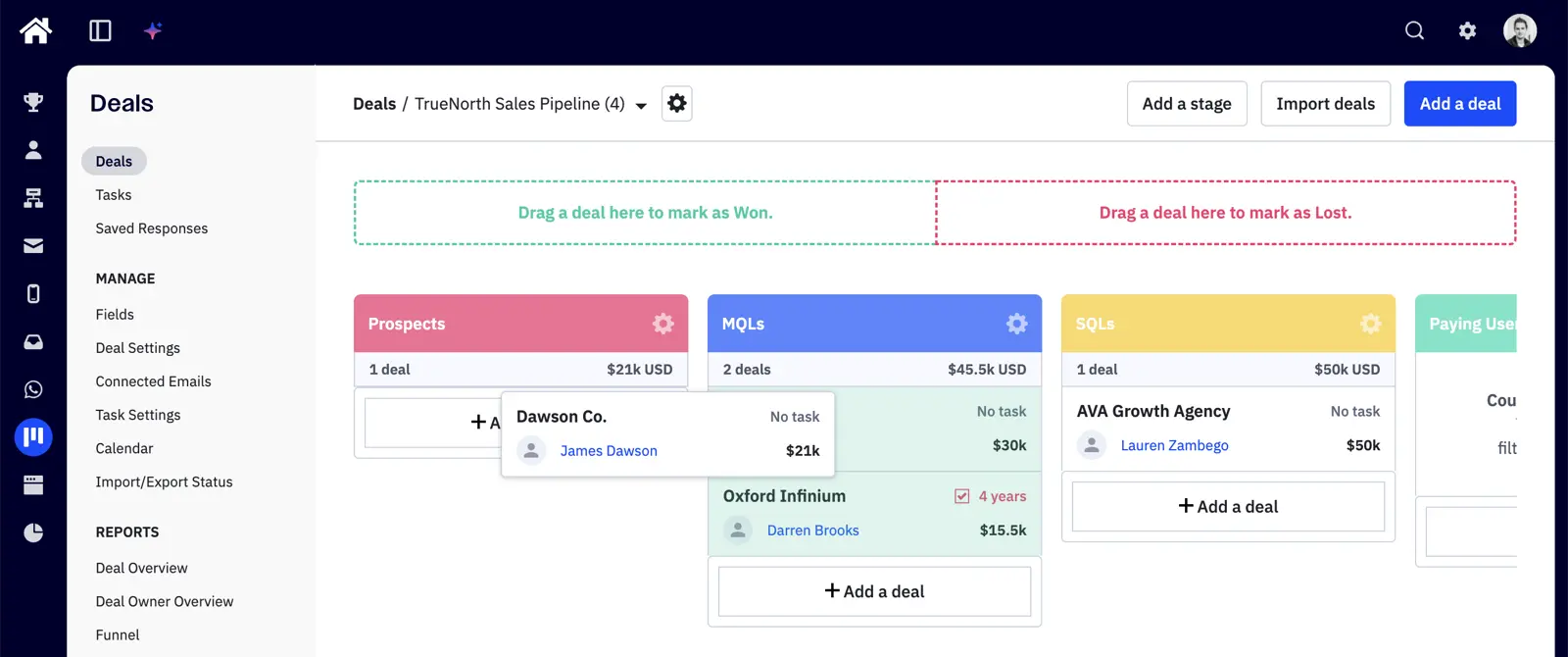
That has been useful for us when lifecycle stage or lead score should change what someone receives next. In one venture, lead scoring made the marketing-to-sales handoff much clearer.
The CRM itself scored 2.5/5 in my ActiveCampaign review. It gets cumbersome with a large number of deals, and when we have needed a proper sales CRM we have used Pipedrive instead.
ActiveCampaign wins if the CRM data is feeding automations. If sales pipeline management is the main job, pair it with a dedicated CRM.
Round 6: AI features
ActiveCampaign’s Active Intelligence has moved beyond copy prompts. In the latest test, it built a segment from a plain-English request, critiqued an onboarding automation, spotted an unfinished A/B test and suggested a prioritised action plan.
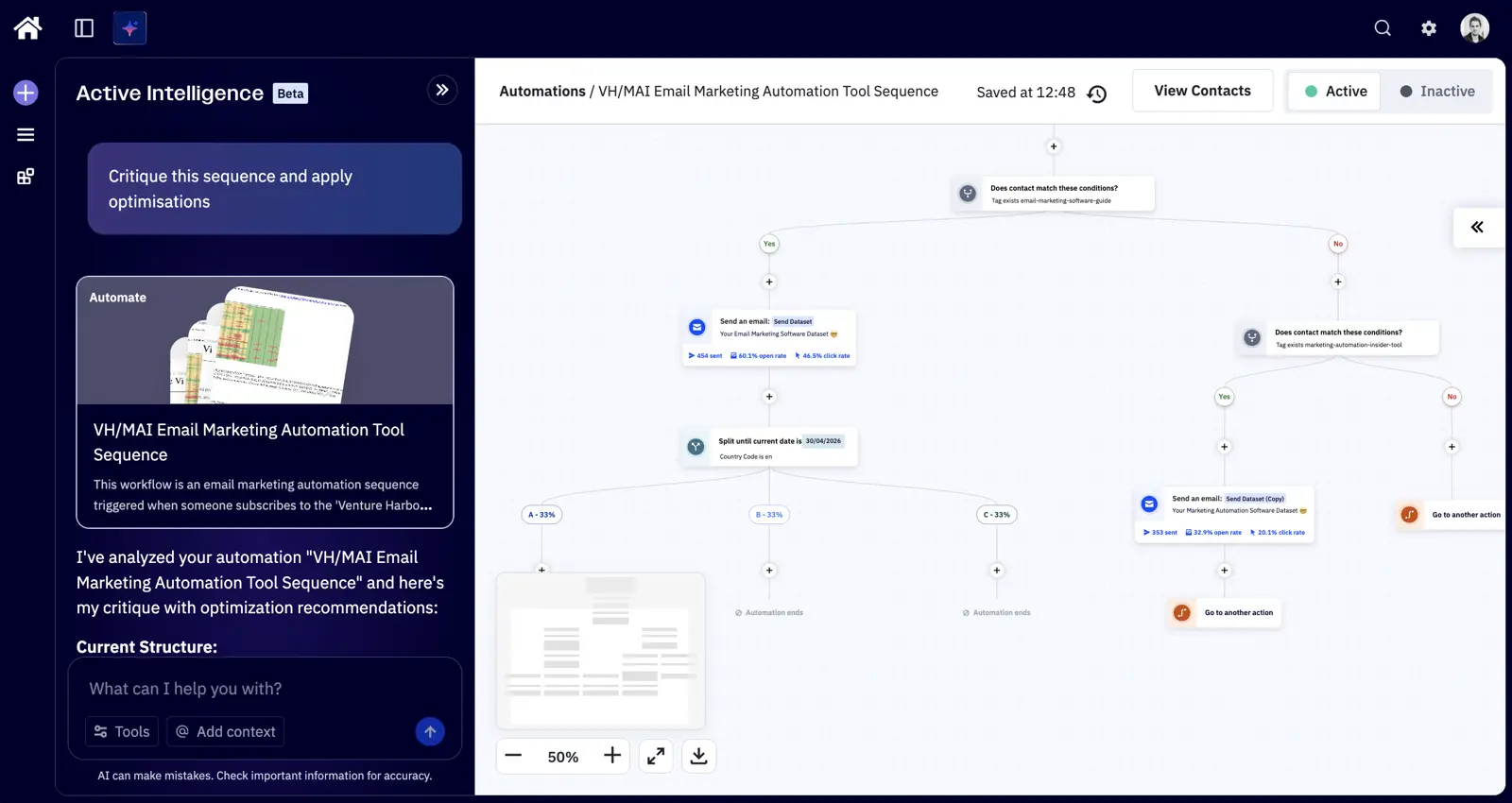
It still needs supervision. The one-shot email build ignored some constraints, and the Claude connector could draft a good activation sequence but could not build the automation itself.
Mailchimp’s AI is useful in a narrower way. Intuit Assist can generate text variants, subject lines and content blocks, while Analytics AI can summarise campaign performance in plain English.

The Claude connector was interesting but awkward. It created a multi-channel plan and imported editable drafts into Mailchimp, but I could not simply ask it to create one campaign directly.
ActiveCampaign wins this round because its AI was better at segmentation and journey critique. Mailchimp’s AI is helpful inside the editor, with less strategic depth.
Round 7: Support
ActiveCampaign support has been useful across 14 years of use, especially around API work. The problem is that reaching a human now takes more effort than I expect from a premium-priced platform.
The AI assistant answered my activity-credit question quickly in the latest test. That is fine for simple product questions, but billing and deliverability issues still need an obvious human route.
Mailchimp did better in its September 2026 support test. I asked a deliberately awkward billing question with a false premise, and the agent gave the right answer within eight minutes.
The form was irritating because the first message was capped at 170 characters. Once I got through that, the answer was useful and did not push me towards a higher bill.
Mailchimp wins on the latest evidence. I would still treat support as plan-dependent, because priority routes and phone support vary by tier.
Switching between Mailchimp and ActiveCampaign
Moving from Mailchimp to ActiveCampaign makes sense when you need more control over automations, segments and CRM-triggered email. ActiveCampaign offers a free migration service, plus a direct Mailchimp import if you want to handle the contacts yourself.
The reverse move can make just as much sense if those features have become overhead. Mailchimp accepts contact imports and gives you a simpler place to rebuild newsletters and basic journeys.
In either direction, the CSV is the easy bit. You need SPF, DKIM and DMARC in place, then time to rebuild the templates, journeys, tags and behavioural segments you still use.
For a small list, I would budget a day or two for a careful DIY move. Keep the old account active for 30 days so you can check campaigns, templates and reports while the new setup settles.
The case for staying with Mailchimp
Mailchimp is a good choice if you send newsletters, product announcements, simple lead nurture or early eCommerce email and want the tool to stay out of the way. The editor is the best I tested, the free plan is useful for a tiny list, and the Standard plan gives most small teams enough capability for the money.
Paying for ActiveCampaign to send the occasional newsletter would be daft. You would be buying automation depth you do not use.
Mailchimp becomes less suitable when you need lifecycle sequences, sales-stage triggers, behavioural segmentation, automation testing or AI critique of journeys. ActiveCampaign is built for that work, although it costs more and takes longer to learn.
If ActiveCampaign feels too heavy but Mailchimp feels too light, our Mailchimp alternatives guide covers the wider field.
Verdict
Choose ActiveCampaign if you need detailed automations, behavioural segments and CRM triggers. It gives you more control, with a higher bill and more setup work.
Choose Mailchimp if you want to build polished campaigns quickly and keep your journeys simple. Its automation has limits, but many owner-operators and small teams will never need the extra complexity.