


When we were evaluating webinar platforms for one of our ventures, the shortlist came down to two names fairly quickly: Demio and Livestorm. Both are modern, browser-based and pleasant to use — which already puts them ahead of most of the category.
Before we go further, two disclosures. First, this post contains affiliate links, which means we may earn a commission if you sign up through them. Second, we ended up choosing Demio for our own marketing webinars, so I’m not a neutral bystander here — though as you’ll see, there are plenty of situations where I’d point you at Livestorm instead.
Here’s the gist. Demio and Livestorm look similar from a distance, but they’re built for different jobs.
Demio is a marketing tool that happens to run webinars. Everything about it — the timed offers, the like-live replays, the branded registration pages — is angled at turning attendees into leads and leads into customers.
Livestorm is a video engagement platform that happens to be good at webinars. It also handles product demos, customer onboarding and team meetings, all from the browser, all with a clean interface your sales team won’t complain about.
If you’re a marketing team running webinars to generate pipeline, get Demio. If you’re a SaaS team running demos, onboarding sessions and the odd webinar, get Livestorm. The rest of this post is the reasoning — and the trade-offs the one-line verdict glosses over.
Demio vs Livestorm at a glance
| Demio | Livestorm | |
|---|---|---|
| Best for | Marketing-led webinars and lead generation | SaaS teams running demos, onboarding and meetings |
| Live webinars | Excellent — engagement-heavy | Excellent — polished, browser-based |
| Automated webinars | Winner — like-live replays and hybrid formats | Good — automated sessions and replays |
| Engagement tools | Winner — polls, offers, handouts, Q&A | Solid, but less conversion-focused |
| Beyond-webinar use cases | Limited — it’s a webinar tool | Winner — demos, onboarding, meetings |
| Ease of setup | Easy | Slight winner — the cleanest UX in the category |
Both platforms run entirely in the browser, so your attendees never hit a “please download our 200MB desktop client” screen. That alone rules out a chunk of the older competition.
A note on pricing before we start: I’ve deliberately left specific numbers out of this post. Both platforms revise their plans often enough that any figure I quote would be stale within months — check the current pricing pages for Demio and Livestorm before deciding. What doesn’t change is the shape of the decision, which is what the rest of this post is about.
Live webinars: both good, differently good
Live events are the baseline, and neither platform embarrasses itself here.
Demio’s live rooms are built around keeping marketers in control of the conversation. You get public chat, plus private messaging so attendees can quietly flag issues to event coordinators without derailing the main thread. Registration pages are branded to match your business rather than screaming “third-party webinar tool,” which matters more than it sounds — a janky registration page is the first place trust leaks out of your funnel.
There’s also a “stay registered” series feature, which lets people sign up once for an ongoing run of webinars. If you host a recurring show — a monthly product teardown, a weekly office hours — this quietly removes a registration hurdle from every session after the first.
Livestorm’s live experience is arguably the nicer of the two to sit in. The whole platform is beautifully designed, from the registration landing pages through to the live room, and everything works from a browser tab on any device. It also plays well with the tools around it — Livestorm integrates with common marketing platforms like HubSpot and Salesforce, so your webinar data doesn’t live in a silo.
The honest trade-off: Demio’s live rooms are optimised for conversion, Livestorm’s for experience. Neither is wrong. It depends whether your webinar’s job is to generate pipeline or to make your product look good.
Automated webinars: Demio’s home turf
This is where the two start to separate.
Demio offers live, automated and hybrid webinars — the hybrid option mixing pre-recorded segments with live ones. Its like-live replays recreate the live experience for people who registered but couldn’t attend, or who found the webinar weeks later. For evergreen lead generation, this is the feature that pays the bills: record a strong webinar once, then let it keep collecting email addresses while you get on with something else.
Livestorm handles automation too, to be fair. It offers automated webinars, automatic replays and automation sequences, and for most teams that’s plenty. If your automated needs stop at “send the recording to registrants and let people watch on demand,” Livestorm covers it without fuss.
But if automated webinars are the strategy rather than a nice-to-have — if you’re building an evergreen funnel where the webinar is the conversion event — Demio’s hybrid formats and like-live replays give you more to work with. That’s the specific reason it won our own evaluation.
One caveat worth naming: if evergreen automation is all you care about, it’s worth also looking at the dedicated automation tools in our full webinar software comparison. Demio is the best all-rounder here, but it’s not the only way to run webinars in your sleep.
Engagement tools: Demio wants your attendees to do something
A webinar where attendees passively watch slides for an hour is a YouTube video with extra scheduling admin. The engagement features are what justify the format.
Demio leans into this hard. During a session you can run interactive polls, launch offers with call-to-action buttons, share live document handouts and run Q&As. The offers feature is the standout for marketers — when you hit the pitch section of your webinar, a clickable CTA appears in the room, so the distance between “I’m interested” and “I’ve clicked” is one button.
It’s telling who uses Demio: the marketing teams at Proof, Drip and OptimizePress, among others. These are people whose entire business is conversion, and they’ve voted with their webinar budgets.
Livestorm isn’t bare here — you get polls and can quiz live attendees in real time, plus the chat and Q&A features you’d expect. For a product demo or an onboarding session, that’s exactly the right amount of interactivity. Nobody wants a timed discount offer popping up mid-onboarding.
The downside of Demio’s approach is the flip side of its strength. All that conversion machinery is pointless — occasionally counterproductive — if your webinars aren’t sales-driven. Run an internal training session through Demio and you’re paying for offer buttons you’ll never press.
If engagement is your weak spot generally, the tooling only gets you so far — we’ve written separately about how to boost your webinar attendance rate, which is usually the bigger lever.
Beyond webinars: Livestorm’s home turf
Here’s where the comparison flips.
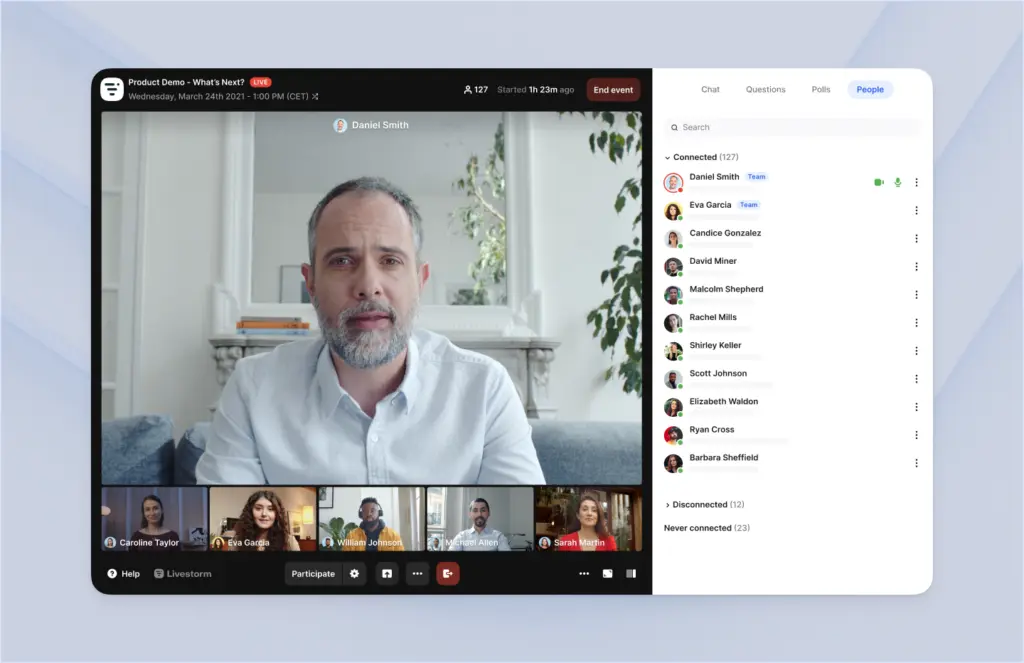
Demio does one thing: webinars. That focus is why its webinar features are so sharp, but the moment your needs stretch beyond that — sales demos, customer onboarding calls, team meetings — you’re shopping for a second tool.
Livestorm was built for exactly this. Beyond marketing webinars, it handles product demos, customer onboarding sessions and instant meetings, positioning itself as a replacement for your general video meeting software as well as your webinar platform. It even integrates with collaboration tools like Miro for more interactive sessions.
For a SaaS company, this is genuinely useful. Your SDRs run demos, your customer success team runs onboarding, your marketing team runs webinars — and it’s all one platform, one set of branding, one analytics view, one invoice. There’s a real operational argument for that consolidation, quite apart from the features.
Being based in France, Livestorm is also a sensible option for organisations serving EU or UK contacts who need to be GDPR compliant — not a differentiator that gets pulses racing, but one that gets procurement approvals signed.
The trade-off, again, is the mirror image. A platform that does four jobs rarely does any single one of them better than the specialist. Livestorm’s webinar features are good; Demio’s are better. You’re choosing between depth and breadth, and only you know which your team actually needs.
If your events are bigger than webinars altogether — virtual conferences, summits, expos — neither of these is the right shape, and you’d be better off with our virtual event platforms comparison.
Ease of setup: no losers here
I’ll keep this section short because there’s not much of a fight to referee.
Both platforms are browser-based, both are modern, and both can get you from signup to a scheduled webinar quickly. Neither requires attendees to download anything, which — if you’ve ever watched your show-up rate die on an installer screen — is worth more than any individual feature.
If forced to pick, Livestorm edges it. The user experience is unusually clean for this category, from registration pages through to the live room, and non-marketers on your team will find their way around without a training session.
Demio is hardly difficult, though. Its extra marketing machinery means marginally more to configure, but it’s the good kind of complexity — settings that exist because they earn their keep.
Which should you pick?
If you’re a marketing team running webinars for lead generation: Demio. The engagement tools, like-live replays, hybrid formats and branded registration pages are all pointed at the same goal — pipeline. This is what we chose for our own venture, and the reasoning hasn’t changed since.
If you’re a SaaS product team: Livestorm. When webinars are one of several video touchpoints — demos, onboarding, meetings — Livestorm’s breadth beats Demio’s depth. Add the HubSpot and Salesforce integrations and the GDPR-friendly EU base, and it’s the more natural fit for software companies.
If you’re an agency running webinars for clients: it depends on the clients. Demio’s branded registration pages make it easy to keep each client’s events looking like their own, while Livestorm’s cleaner reporting and CRM integrations make the results easier to hand over. I’d lean Demio if the webinars are lead-gen campaigns, Livestorm if they’re part of a broader customer communication programme.
If you’re a course creator: honestly, look at WebinarJam before either of these. The webinar-as-live-sales-event model that course businesses run is what the WebinarJam and EverWebinar ecosystem was built around — we cover it properly in our full webinar software comparison. Demio would be my pick of the two platforms in this post, but it wouldn’t be my first call.
Whichever you land on, remember the platform is the smaller half of the equation. A mediocre webinar on excellent software is still a mediocre webinar — our guide to webinar marketing tips covers the promotion side that actually fills the room.
The verdict
Demio wins this comparison for us — but only because of what we use webinars for.
Our webinars exist to generate leads, and Demio is the sharper instrument for that job. The moment our needs shifted towards product demos and customer onboarding, I’d move to Livestorm without much agonising. It’s the rare case where both tools are good enough that the deciding factor is your use case, not their shortcomings.
Try both. Each offers a way to test the platform before committing, and an hour inside each live room will tell you more than any comparison post — this one included.