


We ran hiring at Venture Harbour on Breezy HR for over five years. Six hires, 900+ applications, dozens of interviews — I wrote up the full experience in our Breezy HR review.
So when I say most people searching for Breezy alternatives don’t need one, it’s not a lazy take. It’s the conclusion of half a decade on the product.
But Breezy has real gaps. The reporting is light, there’s no candidate sourcing database, and the HR side stops at hiring. If you’ve hit one of those walls, this post covers the eight alternatives I’d actually consider — and the specific situation each one wins in.
The quick answer
Leave Breezy if one of these describes you:
- You need to source candidates, not just collect applications → Workable
- You’re a scaling startup that wants proper hiring analytics → Ashby
- You want AI features on a tight budget → Manatal
- You’re a tech company hiring at serious scale → Greenhouse
- Employer branding is your competitive edge → Teamtailor
- You want hiring, onboarding and HR in one platform → BambooHR
- You’re a UK small team hiring mostly through UK boards → GoHire
- Your recruitment budget is zero → Zoho Recruit
Stay on Breezy if you’re a team under ~200 people hiring reactively — post a job, screen applications, interview, hire — at fewer than 50 roles a year. That’s the workload Breezy is built for, and none of the tools below beat it there. More on that at the end.
One thing to watch before you pick: the pricing model matters as much as the price. Breezy charges a flat fee with unlimited users. Several alternatives charge per seat or per employee, and for startups under 50 people, flat-rate almost always works out cheaper — a lesson from testing ten ATS platforms that surprised me with how often it decided the winner.
How the alternatives compare
| Tool | Best for | Pricing model | Standout feature |
|---|---|---|---|
| Workable | Built-in sourcing | Flat tiers from $299/mo (steps up with headcount) | 400M+ searchable candidate database |
| Ashby | Scaling startups | Flat $400/mo (Foundations, under 100 employees) | Best-in-class hiring analytics |
| Manatal | AI on a budget | Per seat, $15/user/mo (annual) | AI Interviewer + 600M+ sourcing hub |
| Greenhouse | Tech companies at scale | Annual quote, scales per employee (~$6,000+/yr) | Structured hiring + 500+ integrations |
| Teamtailor | Employer branding | Per job slot (quote-only), unlimited users | No-code career site builder |
| BambooHR | End-to-end HR | Per employee (~$10/employee/mo, $250/mo min) | ATS + onboarding + payroll + records |
| GoHire | UK small teams | Flat rate from $99/mo, unlimited users | UK job boards (Reed, Totaljobs) |
| Zoho Recruit | Free | Free tier; paid from $25/user/mo | Forever Free plan, no time limit |
01Workable — if you need to find candidates, not wait for them
The biggest thing Breezy doesn’t have is a sourcing database. When we hired through Breezy, every candidate came to us — we posted to 50+ boards and screened whoever applied. That works for most roles. It doesn’t work for hard-to-fill ones.

Workable’s answer is a searchable database of over 400 million candidates, filterable by employment history, role and specific skills. It’s the closest thing to a built-in LinkedIn Recruiter I’ve seen inside an ATS, and it means you can run outreach campaigns instead of hoping the right person sees your Indeed listing. Note that database access appears to be limited to annual plans.
The downside is cost. Standard starts at $299/mo — nearly double Breezy’s $157/mo Startup plan — and the add-ons stack: texting is $89/mo, video interviews $109/mo, assessments $59/mo. All things Breezy includes or prices lower.
Skip Workable if you hire reactively. You’d be paying a premium for a candidate database you never open. The 15-day free trial includes the full Standard feature set, so you can test whether the database actually surfaces people for your roles before committing.
02Ashby — if you’ve outgrown Breezy’s reporting
Reporting is Breezy’s weakest area — I scored it 3.5/5 in our review. Fine at six hires over five years. Not fine at fifty hires a year.
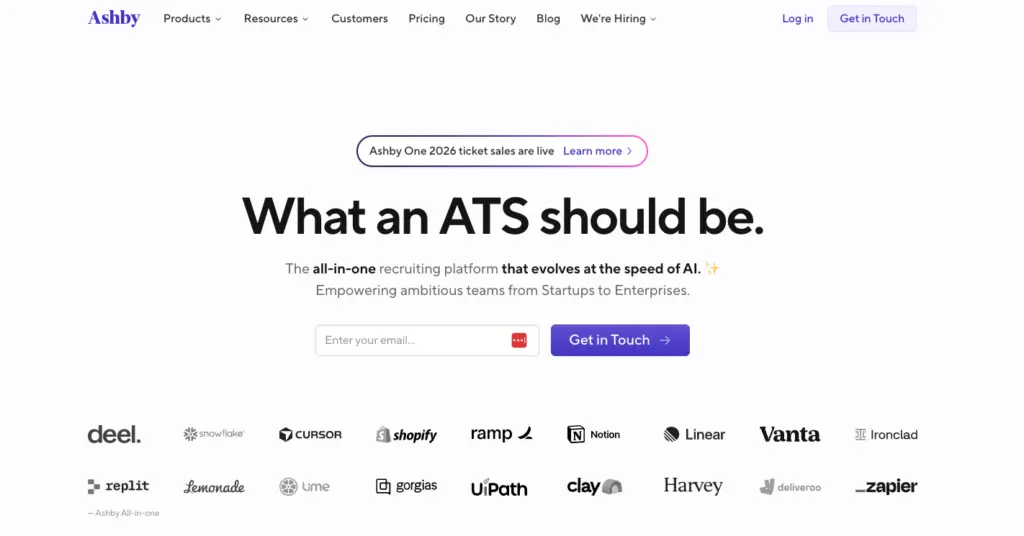
Ashby is the platform I’d move to when the reporting wall hits. It gives you pass-through rates by stage, interviewer calibration, source effectiveness and pipeline-health data — the metrics a Head of Talent at a Series B startup actually needs. It also bundles ATS, CRM and scheduling into one product, and the Foundations plan is a transparent $400/mo for companies under 100 employees.
Here’s the thing about Ashby though: it punishes casual users. Setup takes weeks, not hours (the scheduling system alone has 14 tabs of settings), there’s no free trial, and the interface is English-only. Breezy’s pitch is that anyone can use it on day one. Ashby’s pitch is the opposite.
Skip Ashby if nobody on your team owns recruiting as their actual job. A founder doing occasional hires will spend more time configuring it than hiring through it.
03Manatal — if you want AI features without the bill
At $15 per user per month (annual), Manatal is the cheapest serious alternative on this list — and it’s not a stripped-down product at that price. You get AI candidate scoring, profile enrichment from LinkedIn and 20+ social platforms, a sourcing hub of 600M+ profiles, and an AI Interviewer that runs automated first-round video screens.
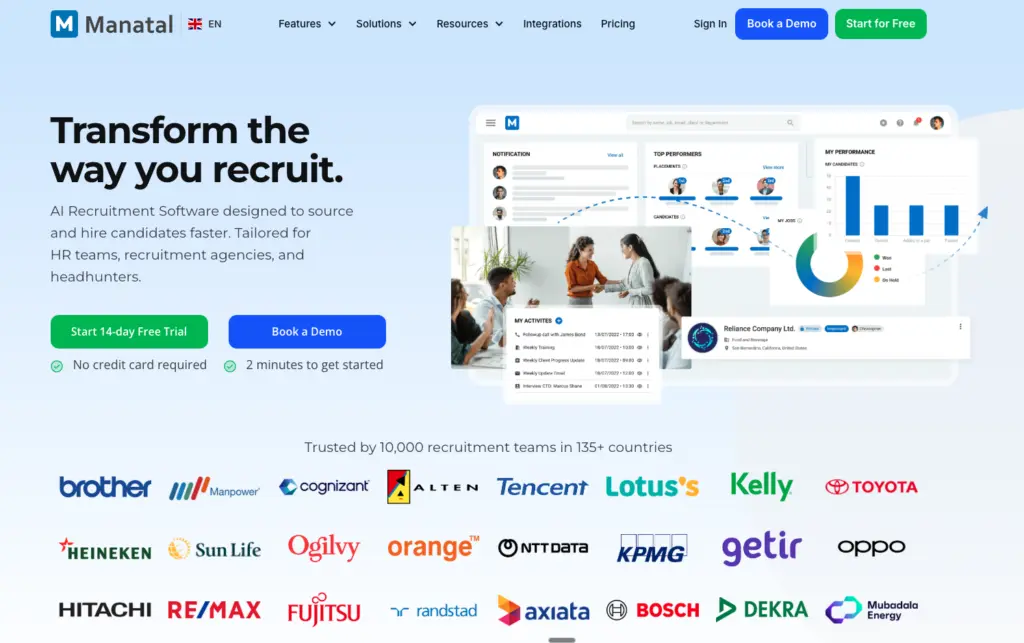
That last one deserves a mention. For high-volume roles where you’d otherwise spend days on phone screens, an AI-conducted first round with generated assessment summaries is a real time-saver, not a gimmick.
The catch is depth. Reporting is basic, customisation is limited, and the career page builder feels like an afterthought. And it’s per-seat pricing — cheap at two recruiters, less cheap at ten (hiring managers are unlimited, which softens this).
Skip Manatal if you need polished employer branding or data-driven hiring reports. For a small team that wants candidates in the door fast and cheap, it punches well above its price.
04Greenhouse — if you’re a tech company hiring at scale
Greenhouse is the reference standard for structured hiring: interview kits, standardised scorecards, anonymous candidate reviews, in-app bias prompts, and the largest integration marketplace of any ATS (500+ partners). For tech companies competing on candidate experience, it’s the procurement-safe choice.

It’s also a different category of spend. Core typically runs $6,000–$10,000 a year for companies under 50 employees, climbing steeply with headcount, and implementation adds $2,000–$8,000 on top. Annual contracts only.
I made this point in the Breezy review and I’ll repeat it: for sub-50-employee teams, Breezy gets you 80% of the value at roughly 25% of the cost. Greenhouse only makes sense when a defensible, structured process across dozens of hires a year is worth paying enterprise prices for.
Skip Greenhouse if your budget is under $500/mo. At that level Ashby gives you more for the same money at scaling-startup stage, and Breezy saves you thousands below it.
05Teamtailor — if your careers page is a marketing asset
Teamtailor treats hiring as a branding exercise, and its no-code career site builder is in a league of its own. Your talent team — not your developers — can build polished career pages with culture videos, team stories and department spotlights. Breezy’s career site is competent; Teamtailor’s is a competitive weapon.
As a pure pipeline tool it’s capable but not class-leading, and the reporting lacks depth for data-heavy teams. The pricing model is the unusual bit: unlimited users, but you pay per active job slot, quote-only, on 12-month minimum contracts (with 3–8% renewal escalators worth negotiating out). Small teams with 1–5 active jobs typically pay around $2,750–$5,000 a year.
That job-slot model cuts both ways. Stable, moderate hiring volume and it’s fair value. A hiring spike and the maths turn against you fast.
Skip Teamtailor if you’re scaling quickly or you need transparent, self-serve pricing. It’s strongest for European companies competing for talent on culture and brand.
06BambooHR — if you want the whole HR stack, not just an ATS
Breezy stops at hiring (Onboard is a paid add-on, and there’s no payroll or employee records). BambooHR keeps going: applicant tracking, onboarding workflows, employee records, time tracking, benefits administration and native US payroll, all in one platform.
For a startup that would otherwise buy three or four separate tools, the consolidation case is strong. The onboarding handoff — offer letter to first-day workflow without switching systems — is the piece Breezy users will envy most.
The trade-offs: pricing is per employee (~$10/employee/mo on Core, $250/mo minimum for teams of 25 or fewer), so your bill scales with company size even if hiring stays flat. Every quote requires a sales conversation. And the ATS itself is shallower than Breezy’s — active job caps start at 5 on Core, and bigger hiring teams will outgrow it.
One adjacent note: if your actual problem is employing people in countries where you have no legal entity, no ATS or HRIS solves that — that’s employer of record territory.
Skip BambooHR if you only need applicant tracking. Buying a full HR suite for the ATS alone is paying for a house because you liked the kitchen.
07GoHire — if you’re a UK team hiring through UK boards
GoHire is the tool we came closest to switching to ourselves. It’s UK-built, it starts at $99/mo (£89) with unlimited team members, and it integrates properly with Reed and Totaljobs — boards that US-focused platforms treat as an afterthought. It also ships 700+ UK-tailored job description templates and gives registered charities 30% off.
The pricing model mirrors what makes Breezy work for small teams: flat rate, unlimited users, no per-seat surprises. At $99/mo it undercuts every serious competitor on this list.
The compromise is reach and depth. Distribution covers 15+ job boards versus Breezy’s 50+, the reporting lags Ashby and Greenhouse, and you’ll need the $299/mo Pro tier for video questionnaires and automated stage actions. The Starter tier also caps you at 3 active jobs.
Skip GoHire if you hire outside the UK or need wide job-board syndication. For a UK small business hiring domestically, it’s the price-performance pick — and the 14-day trial needs no card.
08Zoho Recruit — if the budget is zero
Zoho Recruit’s Forever Free plan is the most usable free ATS available: one active job, candidate management, email integration and interview scheduling, with no time limit. You can run a complete hiring cycle without paying anything. Paid plans start at $25/user/mo (annual), and if your business already runs on the Zoho ecosystem, the native integrations make it close to a default choice.
Now the honesty bit. The interface feels dated next to Breezy or Teamtailor, initial setup has a steeper learning curve than it should, and support can be slow on lower tiers. Candidates will notice the difference too — the career page builder is basic.
Worth remembering that Breezy also has a free Bootstrap plan with one active position and a far more polished pipeline. If free is the requirement, compare those two before deciding Zoho wins by default.
Skip Zoho Recruit if candidate experience matters to your brand. Take it if the alternative is running hiring out of a spreadsheet.
When staying on Breezy is the right call
Here’s the section most “alternatives” posts won’t write.
We processed 900+ applications through Breezy and I’d still recommend it without hesitation to most growing businesses. If you’re under ~200 employees, hiring fewer than 50 roles a year, and your process is reactive — post a job, screen, interview, hire — Breezy’s combination of Kanban pipeline, stage-action automation and flat-fee unlimited-user pricing is not beaten by anything above. At $157/mo (or free for one active job), several of these alternatives cost two to forty times more for capabilities you won’t use.
Switch for a reason, not for novelty. The reasons that hold up: reporting depth at 50+ hires a year (Ashby, Greenhouse), proactive sourcing (Workable, Manatal), or consolidating HR into one system (BambooHR). Migrating an ATS mid-hiring-cycle is a slog, and I’ve yet to hear anyone say they enjoyed it.
If you’re weighing it up, the full Breezy HR review covers exactly where the product is strong and where it thins out. And if you want the wider field beyond these eight, the applicant tracking systems comparison ranks all ten platforms we’ve tested.